

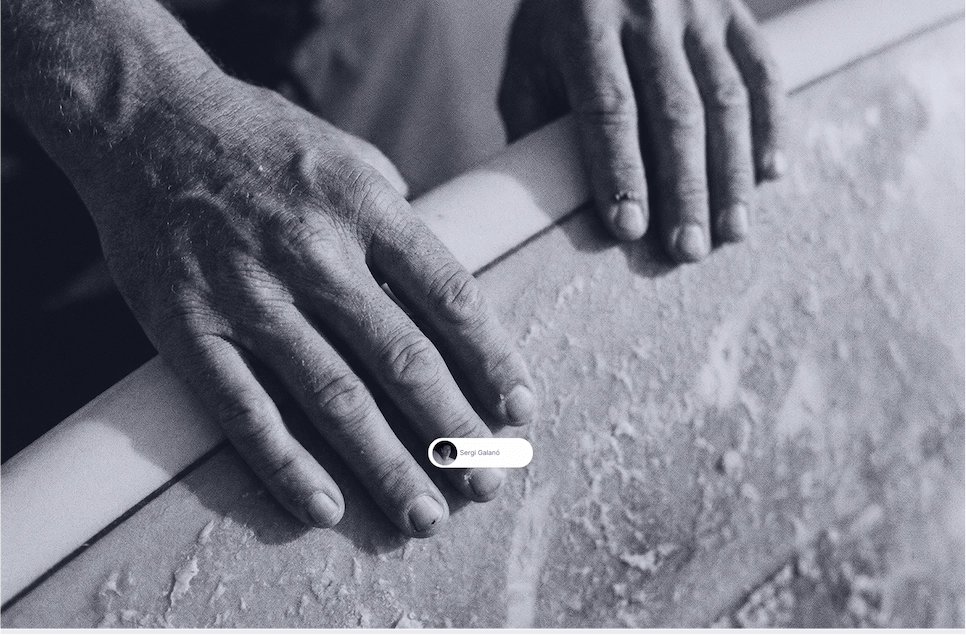
Sergi Galanó
Shaper and founder of Flama Surf.
Sergi is a surfer, shaper, and founder of Flama Surf. Throughout his life, wood, nature, and sustainability have formed a triad that gives meaning to almost everything he does.
Today, he divides his time between two main goals. On one side, continuing to refine his techniques and materials to develop better and more sustainable ways of producing surfboards. On the other, sharing his knowledge through talks, workshops, and training sessions, encouraging more people to question current production models and take part in building more responsible alternatives.
His ultimate pursuit is to discover new materials and processes that can restore a genuine and deep commitment to nature within surf culture.
1. ¿Cómo fue tu proceso personal para llegar a conectar la sostenibilidad con el surf?
Surfeo desde muy pequeño y siempre me ha gustado hacer las cosas por mí mismo. Venía trabajando la madera, viviendo en la montaña, construyendo mis propios muebles… y desde hacía tiempo tenía la idea de hacerme una tabla de surf.
Por un lado, sabía lo complejo que era fabricar una tabla tradicional de espuma y fibra. Por otro, no quería trabajar con los químicos contaminantes y tóxicos que ese proceso implica. Fue entonces cuando descubrí la paulonia, una madera ligera, resistente al agua y con unas propiedades mecánicas que abrían la posibilidad de fabricar tablas completamente de madera, sin necesidad de resinas ni laminados.
Cuando conseguí acceder a este material, dediqué un año entero a investigar cómo transformar esa idea en una tabla funcional. Así empezó mi aventura con Flama. Las primeras tablas eran huecas y algo más pesadas que las convencionales, lo que dificultaba su adopción en el mercado.
A partir de ahí, comencé a experimentar: una segunda tecnología, luego una tercera, una cuarta, hasta una quinta… siempre con la intención de mejorar el rendimiento sin perder el enfoque sostenible y acercar el producto a más personas.
En el fondo, esa búsqueda de hacer algo más sostenible siempre ha formado parte de mí.
2. Are there other leaders in the surf industry working with a vision similar to yours, whether in boards or other products? Is there anyone who inspires you?
Throughout this journey, and through my own process of shaping boards, I’ve come across many people who share the same concerns as I do, each trying to find solutions in their own way. In fact, you could say there’s a small, almost invisible collective of individuals working from their garages, some as a hobby and others professionally, all contributing their own alternatives.
But what’s truly special, what really stands out, is that all of these people are willing to share their experiences and knowledge. They genuinely enjoy it, it makes them happy to open up their processes and ideas to others.
A few years ago, for example, there was an event in Australia called Wooden Surf Day, a gathering of wooden board enthusiasts. Over time, it evolved beyond just wood into a broader focus on sustainable surfboards.
I was invited to Australia to take part in some of these events and give a talk about my boards. Later on, I started organizing similar gatherings myself. We held three in Cantabria, and people came from all over Europe. It was incredible. There were participants from Greece, Italy, Portugal, Scotland, each bringing their own approach and alternative solutions.
At one point, we gathered more than 80 boards on the beach. And for a full day, it was all about sharing experiences.
That spirit of shared knowledge is one of the main reasons that led me to take this next step with Flama Circular. Because I truly believe that it’s through collective learning that we can evolve. And if that ends up inspiring other industries along the way, even better.
3. Do you think there are contradictions between “surf philosophy” and the way surfboards are produced and consumed?
In recent years, the surf community has started to recognize something quite clear: surfing is a sport deeply connected to nature, and surfers have long been perceived as environmentalists. But that perception hasn’t really held true for a long time.
The reality is that most of the materials we use to surf come from petroleum. They are toxic, polluting, and difficult to recycle. In other words, everything surrounding the sport has very little that could be considered sustainable.
Over the past 60 or 70 years, since surfboards shifted from wood to petroleum-based materials, combined with neoprene wetsuits, also petroleum-derived, and the constant travel involved, surfing as a whole has remained far from sustainable.
That’s why, in recent years, the need for change has become increasingly visible. The main barrier now is awareness. Helping people truly understand the issue and realize that alternatives do exist.
Fortunately, many people are already working on solutions. Not only in surfboards, as I do, but also in apparel, wetsuits, footwear, swimwear, and even sunscreens.
The challenge now is to amplify these alternatives. To make them visible. To show that they are viable, accessible, and real.
Because there is an industry we need to push against. One that has been operating the same way for decades, and while it is starting to change, it is doing so slowly.
4. It’s clear you’re a natural creator. How many projects and ideas are currently orbiting around Flama?
I have many projects on the table right now. One of the main ideas I’m developing is a line of surfboards specifically for surf schools. Today, surf schools have expanded rapidly across the world, and many of them rely on boards made from materials that are either unrecoverable or extremely difficult to recycle.
What I’m trying to do is find a way to produce boards using leftover materials from old boards, creating a closed-loop system. The goal is for these boards to be recoverable again at the end of their life cycle.
At the same time, I’m collaborating with the NGO Wonderful, which is developing projects in Mozambique and Angola. My role is to support the early stages of surfing in these regions, where the sport is just beginning to take shape.
In many cases, surfboards there arrive however they can, often coming from Europe or being left behind by tourists. Our intention is to work with this NGO to teach local communities how to build their own boards using available materials. To create African surfboards, made by them, for them. So they can become self-sufficient and not depend on a highly polluting industry that still dominates in Europe, the United States, and beyond.
There are many ideas in motion. And Flama Circular is meant to be exactly that: a space where collaboration can spark and accelerate projects that move us toward a more sustainable way of existing on this planet.


