

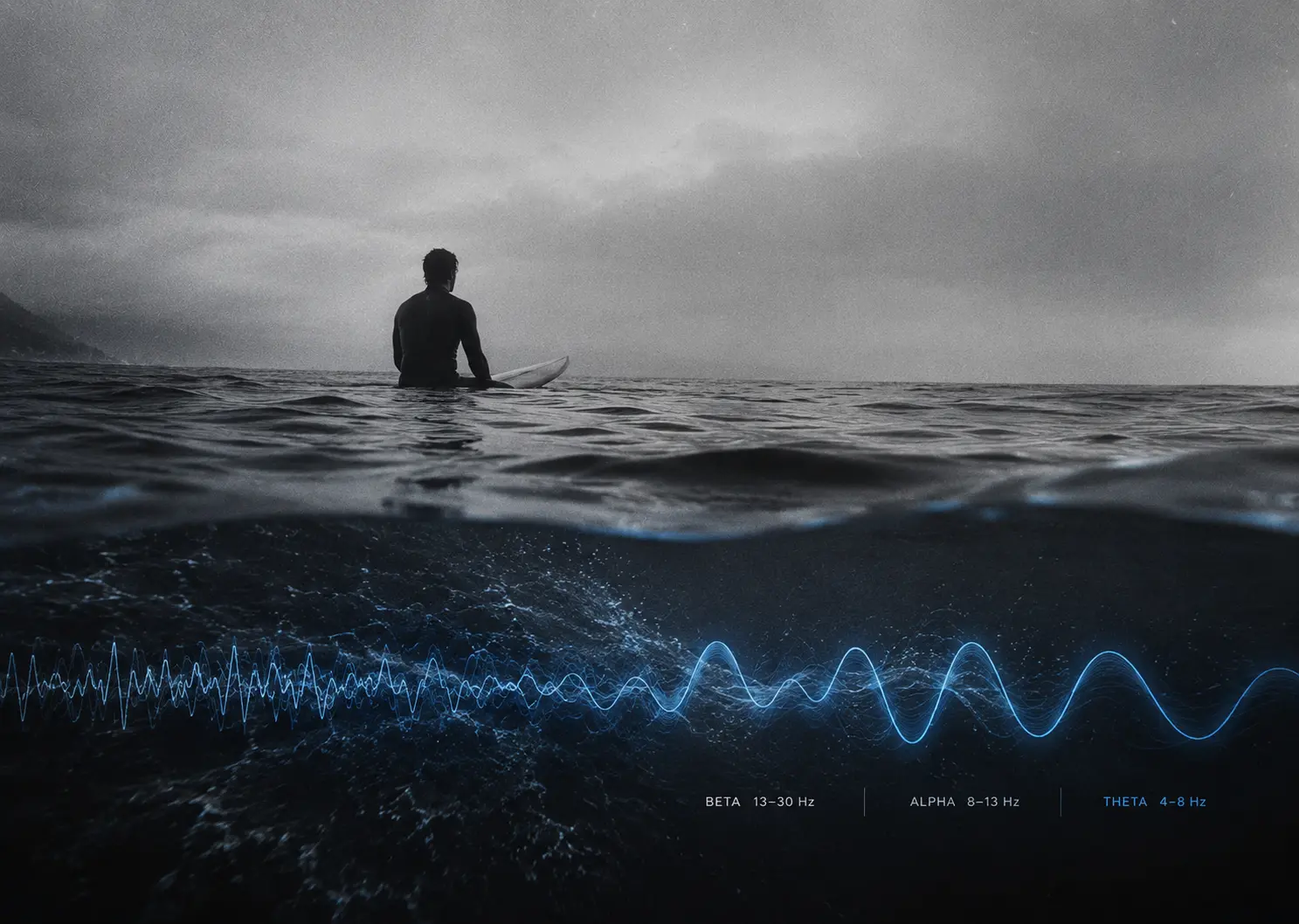
The ocean isn’t just something you see. It’s something you hear. And that sound literally changes the electrical frequency of your mind — before you even catch the first wave.
You’re paddling out to the lineup. The noise of the city disappeared hours ago. The sound of the waves fills every mental space that was occupied by emails, meetings, traffic. You haven’t caught a single wave yet. You’ve already changed.
That moment — before the first wave, before the effort, before the body engages — is the one that interests me most as the creator of Blue Neuroscience. Because there’s no skill involved, no adrenaline, no achievement. Just the sound of water. And something is already happening in the brain that science can now measure.
In the previous article in this series, we talked about Blue Neuroscience as a field: the evidence that the ocean transforms the brain through chemistry, neural architecture, and evolution. Today we go deeper. Into a specific, measurable mechanism that operates even when you close your eyes.
The sound of the waves.
Your brain has frequencies. The ocean has known them for millions of years.
The human brain is never silent. At every moment it produces rhythmic electrical pulses — waves that neuroscientists measure with EEG (electroencephalogram) and classify by speed. Each frequency corresponds to a different mental state.
Beta waves (13–30 Hz) Dominant when you’re focused, under pressure, solving problems. The state you arrive in when you reach the water loaded from the day.
Alpha waves (8–13 Hz) Appear in alert relaxation. Creativity, deep learning, light meditation. The state that begins to activate while you’re paddling out.
Theta waves (4–8 Hz) Emerge in deep meditation and genuine moments of insight. Where the brain processes emotionally. The state the surfer reaches in flow.
The problem with the modern world is that we live trapped in beta. Notifications, deadlines, screens — everything keeps us in a state of permanent alert. And leaving beta voluntarily is extraordinarily difficult.
The ocean does it without asking for any effort. Before you even enter the water.
The rhythm of the waves: the oldest synchronization machine on the planet
A wave forms, grows, breaks on the shore, and retreats. That complete cycle takes between 8 and 12 seconds — which corresponds exactly to approximately 6 breaths per minute, the frequency associated with relaxation and the onset of sleep. [1]
Every surfer knows this in their body before their mind does. It’s the rhythm you read from the lineup, the tempo that dictates when you paddle and when you wait, the cadence your nervous system begins absorbing from the moment you first hear the ocean that day.
Neuroscientists call this phenomenon entrainment: the brain’s natural tendency to align with external rhythms. When you hear a slow, predictable rhythm, your brainwaves, breathing rate, and heart rate gradually synchronize with that tempo. [1]
Waves are natural entrainment machines. No app. No headphones. No instructions. No conscious effort on your part.
And when the sound of the ocean enters the brain, it activates alpha waves — between 8 and 14 Hz — associated with relaxed meditative states, reduced anxiety, and a measurable increase in creativity. [2]
The ocean doesn’t ask you to meditate. It synchronizes you while you paddle.
What the EEG measures — and why it matters
The electroencephalogram (EEG) is the tool that turns the surfer’s experience into irrefutable scientific data. Electrodes placed on the scalp detect the electrical pulses generated by neurons when they communicate. The result is a real-time wave chart — not an interpretation, not a survey: directly measured brain electrical activity.
The sequence documented in studies is consistent: person at rest in an urban environment → beta dominant. Same person exposed to natural ocean sounds → alpha and theta rise, beta falls. [3]
Researchers have examined with EEG the brain dynamics across different frequency bands during natural versus urban environment experiences. Alpha activity is the most reproducible and statistically consistent marker of exposure to the natural environment. [3]
In surf language: what you feel when you arrive at the ocean isn’t suggestion. It has a graph.
Brighton and the nervous system: the experiment that changes everything
Researchers at Brighton and Sussex Medical School found that natural sounds — including ocean waves — shift the nervous system toward parasympathetic activity, measurably reducing the fight-or-flight response. [1]
The autonomic nervous system has two modes: sympathetic (alarm, action, stress) and parasympathetic (rest, digestion, recovery). Most of us arrive at the water in sympathetic mode — loaded from the day, cortisol still circulating, mind in beta. And before catching a single wave, before any physical effort, the sound of the sea begins to move that switch.
Natural water sounds activate the parasympathetic nervous system involuntarily. [4] The brain can’t help it. It responds because it has been programmed to respond for millions of years.
It’s why every surfer knows that the simple act of sitting in the lineup — waiting, watching the horizon, listening — is already enough to change something.
Before the first wave, the ocean has already started working. The sound arrives first.
Surfing and the theta state: when science names what the surfer already knows
This is where the research gets intimate for anyone who has spent real time in the water.
Any surfer who has moved past the first years knows that state without needing to name it. It’s when you stop thinking about the wave and start reading it. When the body moves before the mind decides. When you come out of the water not knowing how much time has passed, unable to remember what you were worried about this morning, with a clarity you can’t achieve any other way.
Neuroscientists call it the flow state. Csikszentmihalyi described it as the optimal experience: the exact point where the level of challenge and the level of skill meet. Both alpha and theta waves are associated with this state — and they modulate in the same way during nature experiences. [3]
Buddhist meditators with decades of practice exhibit this pattern in EEG. Surfers reach it in the water, often without seeking it and without knowing it’s happening.
The monk chose to sit still. The surfer chose the ocean. And the ocean did the rest.
The difference isn’t in the result. It’s in the path. And the surfer’s path runs through water.
The difference isn’t in the result. It’s in the path. And the surfer’s path runs through water.
Sound without sight: what happens when you only listen
One of the most surprising findings in this field is that the effect doesn’t require physical presence at the ocean.
Gazing at the ocean changes brainwave frequency and places the mind in a state of mild meditation. [5] But research on natural sounds shows that listening to waves — without seeing them, without being on the beach — produces similar measurable neurological responses.
The brain doesn’t completely distinguish between the real stimulus and its sonic representation. What matters is the pattern. Predictability with variation. The rhythm that doesn’t threaten and that the nervous system recognizes as safe.
For the surfer who lives far from the sea, it’s also a way of understanding why certain sounds, certain videos, certain memories of waves have a real and measurable effect. It isn’t nostalgia. It’s the brain recognizing a pattern that recalibrates it.
We built an entire wellness industry to replicate what the ocean does for free and without instructions.
The question that obsesses me
If the sound of the waves can shift the nervous system from alert mode to recovery mode in minutes — without effort, without training, without cost — then the question isn’t why we should spend more time near the ocean.
The question is why we have designed a world that moves us away from it.
And the next one, more urgent: if less than 5% of the ocean has been explored, how many sounds, how many frequencies, how many wave patterns exist at depths no human has reached? How much unexplored neuroscience lives down there?
The most sophisticated neurological technology on the planet is 3.8 billion years old. It’s called the ocean.
The next time you enter the water, remember you’re not just surfing. You’re recalibrating your nervous system, synchronizing your brainwaves with the oldest rhythm on the planet, accessing a state that meditators spend years trying to reach.
The ocean knows. Your brain does too. Now you have the data.
About the author
Xavier Rubio Franch is a surfer and the creator of Blue Neuroscience. Founder of The Ocean Connections and Old Surfer Agency. He developed the Green Storydoing and Blue Storydoing concepts and serves as President of the Foundation for Sustainable Consumption. Featured in Forbes Spain. Lives and surfs in Miami.
Sources


