

Marta Estrada Miyares
Marta Estrada Miyares is an oceanographer and marine biologist with a long-standing career at the Institute of Marine Sciences (ICM) and the Spanish National Research Council (CSIC). She stands out as one of the pioneering Spanish scientists conducting research in Antarctica.
For decades, her work has focused on understanding marine phytoplankton and its ecological importance. At 78, she remains active, contributing to projects addressing climate change, ocean health, and marine conservation.
1. What led you to undertake this expedition, and how did it shape your view of the ocean?
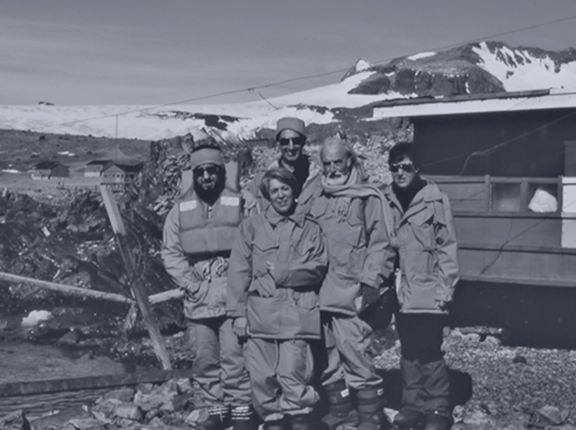
My first visit to Antarctica took place during the austral summer of 1984–1985, aboard the Argentine icebreaker ARA Almirante Irízar. At the time, I was working on marine phytoplankton ecology at the Institute of Fisheries Research in Barcelona, now the Institute of Marine Sciences (CSIC).
A colleague, the chemist Antoni Ballester, had previously participated in a Belgian-Dutch expedition and was deeply impressed by both the landscapes and the potential for oceanographic research in Antarctica. From then on, he actively promoted the idea of conducting scientific research in the region. Thanks to his international connections, in 1984 he received an invitation from the Argentine Antarctic Institute to join the Almirante Irízar campaign with a small research team.
Although the mission of the vessel was mainly logistical, supporting Argentine bases, it also hosted oceanographic research projects during the journey. Antoni Ballester invited me to join, and I did not hesitate. Our team was diverse, combining scientific and documentary perspectives that greatly enriched the experience.
The expedition was highly rewarding, both scientifically and in terms of exposure to the Antarctic environment. Shortly after, the results were presented at the First Spanish Symposium on Antarctic Studies held in Palma de Mallorca in 1985, leading to several scientific publications.
The Antarctic continent and the surrounding ocean are crucial for regulating the climate and global biogeochemical cycles. For example, the Antarctic Circumpolar Current connects the Atlantic, Indian, and Pacific Oceans, forming part of the thermohaline circulation that redistributes heat between the equator and the poles. In addition, Antarctic ice represents around 70% of the planet’s freshwater reserves. Visiting Antarctica makes one deeply aware of these planetary connections.
The Antarctic marine ecosystem has several remarkable characteristics. Phytoplankton, which forms the base of the food web, displays great diversity. The Southern Ocean includes both highly productive areas, typically near the coast, and relatively poor regions where iron, an essential micronutrient for microalgae, is limited.
Sea ice also plays a key role. When not covered by a thick layer of snow, light can penetrate it, allowing microalgae to grow on its underside and within its internal channels. Krill, a fundamental component of the Antarctic food web, feeds on phytoplankton and forms the basis of the diet for many fish and marine animals such as seals, whales, and penguins. During winter, krill survives thanks to the microalgae living beneath the ice, which provide a concentrated food source.
Therefore, the reduction of sea ice caused by climate warming in certain regions of Antarctica poses a serious threat to krill populations and the organisms that depend on them.
2. Your career has focused on the study of phytoplankton. Why is it so important for the health of marine ecosystems, particularly in the Mediterranean?
In simple terms, phytoplankton refers to microscopic unicellular organisms that live suspended in water and contain chlorophyll. These microorganisms play a role in the ocean similar to that of plants on land: they use sunlight, water, carbon dioxide, and nutrients to produce organic matter and reproduce.
They are the primary producers of the pelagic food web, meaning open-water ecosystems, supporting higher trophic levels such as fish, marine mammals, and seabirds. Phytoplankton includes cyanobacteria and a wide variety of microalgae adapted to different marine conditions.
For example, diatoms have silica cell walls with intricate microstructures that have even inspired nanotechnology applications. They thrive in turbulent, nutrient-rich waters and are key players in late winter and early spring blooms in seas like the Mediterranean.
Coccolithophores are covered with calcified plates of remarkable beauty, while other microalgae, such as dinoflagellates, have flagella that allow them to move within the water column and grow in stratified, nutrient-poor waters.
3. Over your years of research, what changes have you observed in the Mediterranean due to climate change and other environmental pressures?
The Mediterranean is a temperate sea with strong seasonality and significant interannual variability. Throughout many research campaigns, I have observed a wide range of conditions: the same week in March can be colder or warmer depending on the year.
For this reason, identifying the effects of climate change on variables such as temperature or sea level requires long-term data series that allow us to distinguish long-term trends from short-term fluctuations. In this regard, the work of Josep Pascual stands out, having collected data for more than 50 years at a station off the coast of l’Estartit, creating the longest and most reliable dataset in the Mediterranean.
These data show that sea surface temperature has increased at a rate of approximately 0.28 ºC per decade, while sea level has risen by about 3 mm per decade. One of the most visible consequences is the increasing frequency of marine heatwaves, which have caused mass mortality events in sessile organisms such as gorgonians and corals.
These are, undoubtedly, deeply concerning observations. In addition, the Mediterranean marine ecosystem faces ongoing pressures from pollution, overfishing, and other human-driven impacts, threatening both marine biodiversity and the essential services the ocean provides.
4.1. Finally, what advice would you give to younger generations who want to pursue science and ocean protection?
There are several levels to consider. First and foremost, it is essential to stay curious and to ask questions. A scientific career requires significant dedication, but it also offers meaningful rewards, including contributing to our understanding of the world and, directly or indirectly, to human well-being.
In terms of gender perspective, I would especially encourage young women interested in science to persevere and not be discouraged by negative stereotypes.
From a practical standpoint, I would advise young people to study thoroughly and to develop skills in English and computing. A strong academic foundation is crucial, particularly for those seeking research scholarships, where academic performance can play a decisive role.
Protecting the oceans and nature in general requires both knowledge and action. It is necessary to combine scientific understanding with a proactive attitude, capable of confronting purely economic interests and ensuring that knowledge translates into responsible stewardship of the natural environment.


